5 Minute Read
So, you just found out you have OCD. Time for some good news and some bad news.
The bad news: OCD SUCKS. OCD is so tough in so many ways. It has a particular way of making you doubt yourself and everything you think you know or feel. OCD can even make you doubt doing things that you know you did or who you know you are.
Right now, you might be saying to yourself:
“Hold on, June. You just said that OCD can make me doubt who I am, how could there be any good news?”
I’ll tell you!
The good news is that OCD is very common–according to NOCD (one of the leading organizations in the treatment of OCD), anywhere from two-to-three percent of all people meet the criteria for OCD at some point or another in their life–to put it in other terms: that’s nearly 1 in 40 people.
But wait, how can that be good news? Because it means you’re not alone. Chances are, you probably already know someone with OCD. Maybe they’re a friend, a family member, or a coworker. Maybe they’re a celebrity you’ve loved for years! You’re not the only one going through this, and there has been a lot (and I mean a lot) of research and time put into finding treatment that just works.
Maybe the gold standard, the absolute best, most effective treatment is something known as Exposure and Response Prevention, or ERP. To understand this, let’s break it down into its two main parts.
1.) Exposure
The first part, exposure maybe sounds like it would be self-explanatory. Essentially, we make a list or menu of your fears, intrusive thoughts, and anxieties–in other words, the obsessions part of OCD–and then expose you to those things without doing the safety behaviors (more on that in a minute).
There are a few different types of exposures. There’s imaginal exposure, where (as the name might suggest) you imagine the thing that scares you. There’s also in vivo exposure, where you actually do the thing that scares you. There are absolutely other types of exposures as well, but these are the main two that we’ll be looking at here.

I know, this probably sounds really scary and, in a way, it kind of is and that’s kind of how we know it’s working. It’s supposed to be at least a little scary. That said, it’s important to remember that your therapist should not be asking you to do any exposure that they themselves would not do. Let me repeat that: Under no circumstances should your therapist ever ask you to do an exposure that they would not also do on their own or with you. The point of exposure is to show you that you can face your fears and still be okay.
It might be helpful to note here that in more orthodox ERP settings, you will likely make an exposure hierarchy, rather than the exposure menu that I mentioned. This is a super important distinction to make. Whereas an exposure hierarchy might say, “First we expose you to X, then Y, then Z…” and so on and so forth, an exposure menu might say, “What level of exposure do you feel you can handle today?” See the difference?
There’s no one right way to do this and one is not inherently better than the other. Rather, the exposure menu approach incorporates ideas from Acceptance and Commitment Therapy (ACT) and queer theory*. Essentially, placing exposures on a menu rather than on a hierarchical scale allows you, the person doing the exposures, to feel more autonomous and agentic in what exposures you are doing at a given time.
2.) Response Prevention
Along with exposure, the second part, response prevention brings us back to that thing I previously mentioned about not doing safety behaviors. If exposures address your obsessions, response prevention addresses your compulsions. In other words, response prevention is the thing that you do while you do an exposure.
What does this mean?
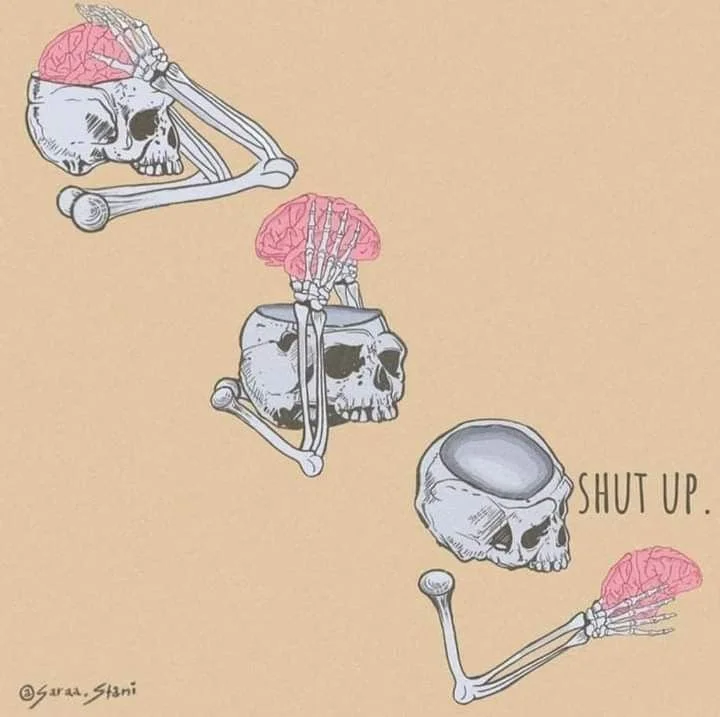
Essentially, response prevention looks like this: during an exposure (this could be imaginal or in vivo), you face the feared condition without doing any safety behaviors or compulsions. This is important because while you might think that a compulsion is alleviating your anxiety, compulsions are actually reinforcing anxiety and obsessive thoughts. Engaging in compulsions teaches you that you cannot face any anxieties. They teach you that you have to do these compulsions in order to remain safe. The reality is, though, that your OCD is lying to you. You are absolutely more than capable of facing anxiety and obsessive thoughts without doing a compulsion.
So, this is a basic overview of the two main parts of ERP, but there is still one more important part: Post Exposure Processing**.
This processing is just as important as the actual exposure and response prevention and it is also one of the most overlooked parts of the process. In a nutshell, post exposure processing asks you to reflect on the experience in order to determine what you gained from it.
While there are so many more questions to ask during post-exposure processing, perhaps the most important is, “What did I learn about myself through this exposure?” By design, exposures teach you a lot about yourself and how you manage fear and anxiety. Maybe you learned something about how your brain and body connect (or don’t!) when facing something anxiety-inducing. Maybe you gained some insight into what your obsessive thoughts are telling you about yourself. Maybe (hopefully!) you learned that you can, in fact, face your fears AND SURVIVE!
–––
Given how in-depth ERP can get, and how powerful the exposures can be, it’s really no surprise that it’s considered the gold-standard, frontline treatment for OCD, and this has been just a tiny taste of what it can look like. Trust me, I know that it can be so scary to start the process of therapy for OCD (and the truth is that OCD often feels worse before it feels better), but when you do decide that you’re ready, consider giving ERP a try.
For more like this (and sometimes some fiction too), follow my Substack: https://substack.com/@junerosecohen
*Thank you to Grace Dickman for introducing me to the idea of queering ERP in her wonderful training through the Q’Lective.
**Check out Juliet Gustafson, @ocd_therapist_juliet on Instagram, for a more in-depth look at this.
***P.S. And don’t worry, if ERP doesn’t work for you, there are plenty of other treatments for OCD as well–stay tuned to my Substack to learn more about the other treatments.